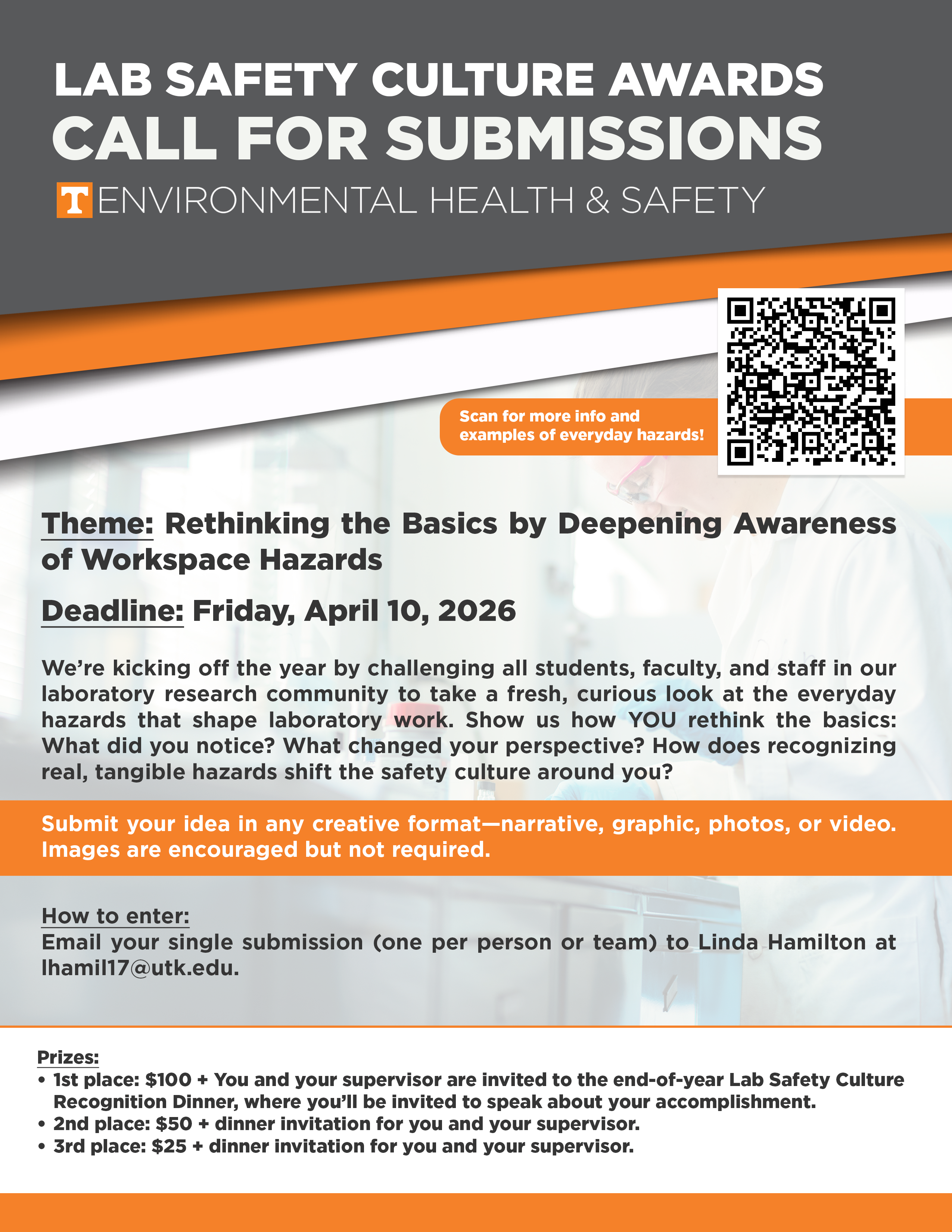
How to enter:
Email your single submission (one per person or team) to Linda Hamilton at lhamil17@utk.edu.
Let your creativity loose—and help us shape a stronger, more mindful, more empowered safety culture across our labs!
Examples of Everyday Hazards:
- Chemical Hazards
- Improperly stored chemicals (e.g., chemicals under the sink that prevent Facilities Services from completing work)
- Incompatible chemicals positioned or stored together
- Missing, broken, or unreadable labels
- Open containers or unsecured solvent waste
- Leaking bottles, damaged caps, or cracked glassware
- Physical Hazards
- Improperly managed clean broken glass
- Trip hazards (cords, boxes on the floor, cluttered walkways)
- Equipment that blocks movement
- Damaged electrical cords, daisy-chained power strips, or exposed wiring
- Hot surfaces (hotplates, ovens, autoclaves) lacking clear signage
- Falling hazards from high storage or unstable shelving
- Biological Hazards
- Unsecured biohazard waste
- Improperly stored samples or cultures
- Misused biological safety cabinets
- Missing, broken, or improper sharps containers
- Radiation Hazards
- Unshielded radiation sources
- Missing or damaged warning signs
- Poorly maintained shielding or PPE
- Equipment & Mechanical Hazards
- Uninspected or poorly maintained equipment (centrifuges, cryostats, lasers)
- Improper guarding on moving parts
- Fume hood sash too high or equipment blocking airflow
- Cluttered or overloaded workstations
- Environmental/Infrastructure Hazards
- Blocked access to soap and towel dispensers that prevents Facilities Services from completing their tasks
- Poor ventilation or failing hoods
- Inadequate lighting in work areas
- Temperature extremes affecting materials or well-being
- Blocked emergency exits or eyewash/shower access
- Ergonomic Hazards
- Poor workstation height or layout
- Repetitive tasks without proper support
- Heavy objects stored too high or too low
- PPE & Process Hazards
- Missing, damaged, or inappropriate PPE for the task
- Inconsistent use of gloves, goggles, or coats
- Improper chemical transport practices
- Unsafe habits that form due to convenience or routine