UTK Environmental Health & Safety Guide LS-022
Exposure to isoflurane waste anesthetic gases has been associated with several health concerns and can occur when vapors escape into the work environment during the administration of anesthesia. This guide illustrates safe practices for isoflurane use.
Effective Date: 07/17/2020
Revision Date: 11/17/2023
Scope and Applicability
The information and practices in this document apply to the use of isoflurane at UTK, UTIA, and GSM.
Definitions and Abbreviations
Definitions
Anesthetic gas: a chemical agent, generally administered through inhalation, used to keep subjects unconscious during surgery.
Waste anesthetic gas: anesthetic gas that leaks from the subject’s breathing mask (or other infusion device) into the air of the workspace.
Laminar flow hood/clean bench: an enclosed box that prevents airborne contamination by providing uniform HEPA-filtered airflow across the work area. These do not offer protection to the user.
Ducted biosafety cabinet: a primary containment device that uses directional airflow to protect the user from hazardous biological and chemical agents inside the workspace and to protect the workspace from contaminated air. These are a special type of biosafety cabinet (Class II, Type B). Most biosafety cabinets on campus are not ducted and do not offer protection from chemical agents.
Vaporizer: a device which controls the vaporization of volatile anesthetic agents from the liquid state.
Induction chamber: a clear chamber that is fitted to the vaporizer where the animal can inhale anesthetic gas.
Abbreviations
ACGIH: American Conference of Governmental Industrial Hygienists
BSC: Biosafety Cabinet
OSHA: Occupational Safety and Health Administration
ppm: parts per million
General Considerations
Isoflurane is a volatile halogenated anesthetic agent frequently used in animal research. It is a clear, colorless, nonflammable, volatile liquid at room temperature and pressure. It has an odor that has been described as ether-like or sweet. Exposure to isoflurane waste anesthetic gases has been associated with several health concerns and can occur when vapors escape into the work environment during the administration of anesthesia.
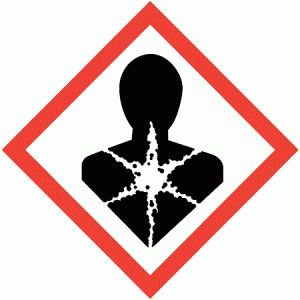
 Health Effects
Acute effects: Headaches, dizziness, lightheadedness, nausea, fatigue, irritability, depression.
Chronic effects: Liver and kidney disease.
Reproductive effects: Some halogenated anesthetics have been associated with birth defects or miscarriages.
Procedures
Minimize Exposure
Those who work with isoflurane should find ways to minimize their exposure when considering the equipment, procedures, and practices to use. OSHA has not established a permissible exposure limit (PEL) for isoflurane; however, exposure threshold recommendations have been established by other groups. The American Conference of Governmental Industrial Hygienists (ACGIH) has established a threshold limit value of 50 ppm over an 8-hour time period. This is a time-weighted average, which puts exposure in terms of a worker’s average daily exposure to a hazardous substance assuming a 40-hour work week or an 8-hour workday. Because the olfactory threshold is 50 ppm, using odor detection to qualitatively assess exposure potential may lead to overexposure. Contact Environmental Health & Safety (EHS) at safety@utk.edu or 865-974-5084 for assistance with exposure assessment.
Active Scavenging (Preferred)
Active scavenging can be described as using negative pressure to draw waste anesthetic gas to the scavenger. Whenever possible, work in a chemical fume hood or hard-ducted Class II, Type B biological safety cabinet (BSC). Other ducted local exhaust ventilation systems such as a downdraft table or point ventilation (e.g. snorkel) may also be useful when used properly. Remember that snorkels must be used a few inches above the workspace to be effective. Ductless fume hoods that rely on activated charcoal filters also help to minimize isoflurane exposure. Laminar flow hoods/clean benches are not active scavenging devices and can even lead to increased respiratory exposure to isoflurane.
Passive Scavenging (Less Effective)
When a fume hood or other local exhaust ventilation is not available, activated charcoal canisters must be used to scavenge waste isoflurane vapors. These passive scavenging devices utilize positive pressure to push the waste anesthetic gas to the activated charcoal filter. Charcoal canisters must be properly installed and maintained in order to be effective. Follow manufacturer instructions as printed on the label. Weigh the canister before and immediately after each use and replace when the weight reaches maximum capacity.
Anesthetic Equipment Maintenance
Anesthesia machines must be maintained annually or as directed by the manufacturer. Fittings, tubing, and connections must be checked routinely, replacing seals and damaged components as necessary. A refrigerant leak detector or soap bubble test should be periodically used to check for gas leaks. Maintenance and repairs should be performed by a certified technician.
Considerations for Working with Isoflurane in Anesthesia Machines
- There are many types of anesthesia machines on campus. Review and understand manufacturer’s instructions prior to use.
- Ensure all users are appropriately trained. Document training and retain documentation for safety and/or regulatory review.
- Verify equipment is currently in working condition, calibrated and certified before each use. Retain calibration and/or certification records for safety and/or regulatory review.
- Use caution when filling vaporizer with isoflurane, as leaks and spills could occur. Wear chemical resistant (e.g. nitrile) gloves, lab coat, and eye protection while filling. Fill vaporizer with isoflurane in a fume hood or ducted BSC. If you must work outside a fume hood or ducted BSC, always use an anti-spill bottle adaptor in a well-ventilated area.
- Avoid high concentrations (>5%) of isoflurane for induction or for prolonged periods.
- Turn off the vaporizer when not administering anesthetic to animals, when retrieving animals from the induction chamber, or when done using a nose cone.
- Close the induction chamber lid during anesthetic gas delivery. If possible, use a sliding top chamber, purge the chamber with oxygen for 3-5 seconds before opening, and stand as far back as possible to keep waste anesthetic gas from entering your breathing zone.
- Use a coaxial nose cone. Select the best-fitting nose cone with a tight-fitting diaphragm to minimize leakage.
- Exhaust waste anesthetic gas to either a fume hood, ducted BSC, or properly weighed and maintained charcoal canister.
- When performing stereotaxic procedures, waste anesthetic gas can escape below the animal’s head. Use a downdraft table, perform the procedure in a ducted BSC, or obtain a device specially made for this procedure.
- For devices that only push isoflurane at only one flow rate, valves and clamps can be applied to tubing to reduce the amount of isoflurane that is being used.
One-Drop or Bell Jar Method: This procedure should be reserved for instances when only a short duration of anesthesia is required (typically 30 seconds for mice or 60 seconds for rats). The procedure must take place in a fume hood, ducted BSC, or suitable ventilated enclosure. A gasketed chamber with an exhaust port to scavenge waste gas may also be used if a fume hood, ducted BSC, or suitable ventilated enclosure is not available. If performing the procedure in the field, choose an area with good ventilation. Stay upwind whenever possible. If performed in an enclosed temporary field station, open at least two sides of the wall tent for air circulation.
First Aid Procedures
If inhaled, remove to fresh air. Call 911 if immediate medical attention is warranted (e.g. loss of consciousness or other emergent condition). In case of skin or eye contact, immediately flush with water for 15 minutes. Use an eyewash for eye exposures. Follow up according to UT Office of Risk Management accident/injury protocols (see https://riskmanagement.tennessee.edu/incident-reporting/).
Spills and Waste
Spills: Small volumes of isoflurane evaporate readily at normal room temperatures and may dissipate before any attempts to clean up or collect the liquid are initiated. If a small spill occurs, rapidly absorb any liquid with absorbent pads or paper towels and place in chemical fume hood for safe evaporation. For large spills of >50 mL (e.g. bottle knocked over or broken bottle), immediately evacuate the area and call EHS for assistance.
Waste: Contact EHS for disposal of unused, expired, or unwanted isoflurane as hazardous waste. Alternatively, contact the Office of Laboratory Animal Care (865-974-5634) to return unused stock solutions to the College of Veterinary Medicine pharmacy. Spent charcoal canisters should be sealed in a plastic bag, properly labeled, and submitted to EHS as hazardous waste. Do not discard in the conventional trash.
For questions about this guidance, contact Environmental Health & Safety (865-974-5084 or ehs_labsafety@utk.edu).
Regulations & References
UT System Policy SA0100
UT System Policy SA0400
ACGIH:Documentation of the Threshold Limit Values (TLVs) and Biological Exposure Indices (BEIs) – Chemical Substances and Other Issues Under Study: Isoflurane. See annual publication for most recent information.